
Introduction to the PDA profile of autism
The PDA Society describes Pathological Demand Avoidance (PDA) as a term widely understood to be a profile of autism found within some autistic people.
This means that people with a PDA profile (PDAers) will share autistic characteristics which are currently defined within diagnostic manuals (ICD-11 and DSM-5) as:
- “persistent difficulties with social communication and social interaction”
- “restricted and repetitive patterns of behaviour, activities or interests”
This often includes sensory sensitivities or differences in relation to sight, smell, taste, touch, hearing, and internal senses such as hunger or thirst.
The PDA Society has lots of in-depth information regarding PDA but what follows here is a snapshot of these resources particularly looking at the key characteristics of this autism profile.
The most well-known feature of PDA is a determined avoidance of so-called ‘common’ or everyday demands of life. On top of more obvious demands, these can also include expectations, and even things the PDAer enjoys doing. However, it’s important to be aware that PDA is not just about demand avoidance, therefore understanding the main characteristics of PDA can help caregivers and professionals offer support and respond with more empathy and understanding.
The main characteristics of a PDA profile are:
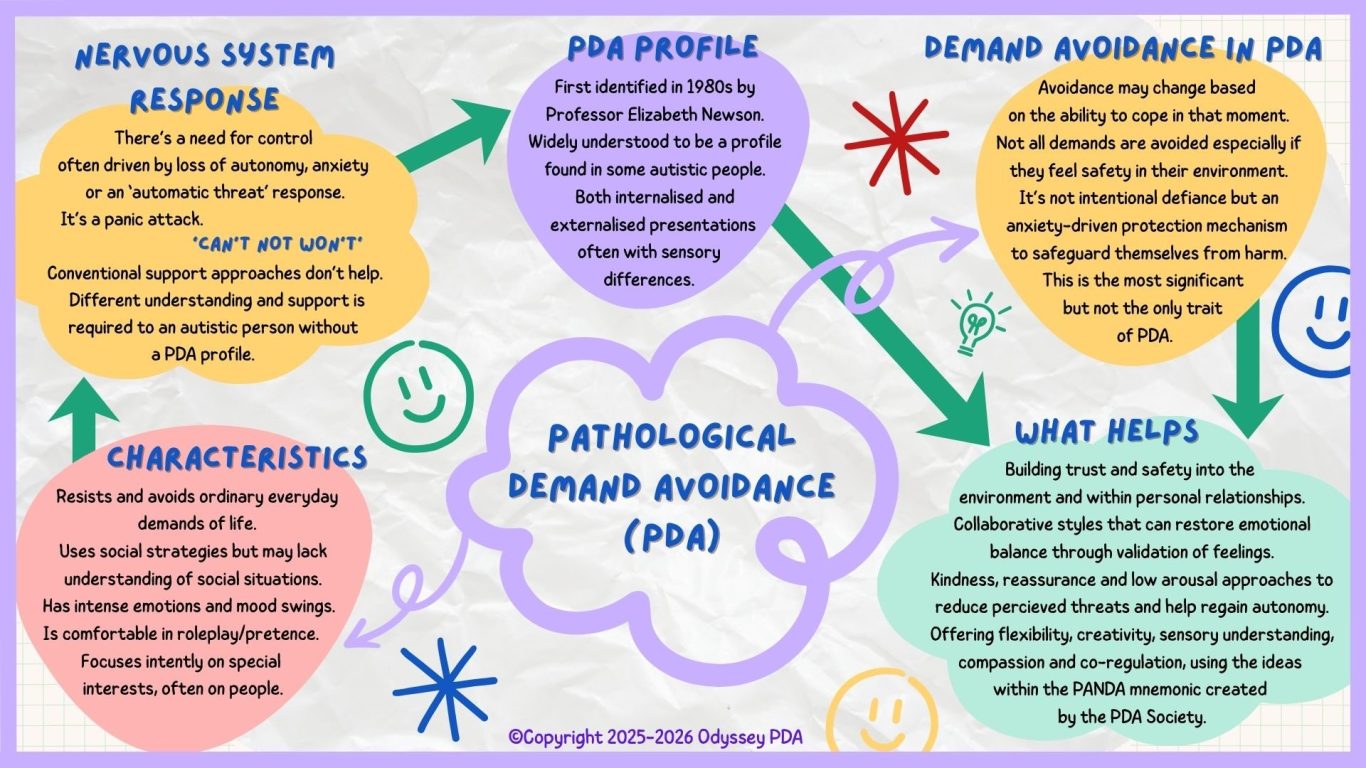
- resisting and avoiding the ordinary everyday demands of life – even things someone needs or wants to do (eg. getting up, drinking, a favourite hobby)
- using ‘social’ strategies as part of the avoidance – perhaps changing the subject, distracting people with humour or flattery, etc.
- appearing sociable, but lacking some understanding – PDAers may appear more sociably ‘able’ than one might expect (with, for instance, more ‘conventional’ use of eye contact or conversational skills) but this may mask underlying differences / difficulties in social interaction and communication (eg. making sustained and deep friendships can be difficult)
- experiencing intense emotions and mood swings – this could also be impulsive behaviour or emotional outbursts that can both escalate and dissipate very quickly.
- appearing comfortable in role play, pretence and fantasy – sometimes to an extreme extent (but not always present). Some PDAers may pretend to be animals or a TV character, others may take on the role of leader / teacher to direct and give instructions.
- focusing intently (hyperfocus) on special interests, often involving other people – with PDA, “repetitive or restrictive interests” are often social in nature, relating to real or fictional people. Strong bonds can also be formed with “safe” people who are perceived as non-demanding, emotionally consistent and predictable but can change suddenly if the relationship starts to feel like a demand.
- a need for control which is often driven by anxiety or an automatic ‘threat response’ in the face of demands – especially when their autonomy feels threatened
- a tendency not to respond to conventional approaches in support, parenting or teaching
In addition to this, PDA children might have delayed language / milestones and, PDAers may rely on masking intensely to manage their anxiety and feel in control.
It is important to remember that:
- a PDA profile of autism is still a spectrum and presents differently in different people – for instance, sometimes it may be internalised, where avoidance may seem more subtle or passive, and in other cases it may be externalised and obvious.
- marked demand avoidance is the most significant, but not the only, trait in a PDA profile.
More information on this can be found within the Practice Guidance documentation published in January 2022 by the PDA Society that collated the professional practice and experience of a multi-disciplinary group of professionals working in the NHS and private practice.
Remember demands cause stress that can affect every aspect of life. Responses are an anxiety-driven response rather than a wilful action or choice. A PDA nervous system is sensitive to threats so having control over autonomy is important and really does help.
What does this mean in reality
PDAers, have an anxiety-driven need for control and autonomy especially when demands and expectations feel overwhelming, or they don’t feel in control of their environment or actions. This need for control leads to avoidance of everyday demands (eg. getting up, eating, going to school or work), including those that are enjoyed like hobbies. It isn’t about being stubborn or defiant; there is a neurological difference where demands and / or lack of autonomy trigger the internal threat response (ie. fight, flight, freeze), rather than it being a choice to be non-compliant.
PDAers need to feel safe and therefore building trusting and strong relationships are key to good support. However increased anxiety and ‘intolerance of uncertainty’ can occur when making decisions, so choices can also feel difficult and can increase distress and cause panic.
Essentially, PDAers have a highly sensitive nervous system, demands (whether direct, indirect or internal) challenge their independence and so the natural reaction is to avoid demands; they’re safeguarding their sense of autonomy and control.
The following graphic offers a visual summary of PDA and what helps, with the next section looking at helpful approaches.
Approaches that can help PDAers
For many PDAers feeling safe and having trusted people whom they can turn to for help is key to reducing anxiety. Traditional support approaches often cause more harm than good; fixed routines, praise and rewards although well-meaning can increase anxiety and reduce trust.
Instead, focus on understanding the PDAer. Flexibility, creativity, compassion and co-regulation will likely be a lot more helpful than seeking compliance and control. Try turning jobs into collaborative challenges or games, embrace technology to help with tasks, or maybe try to see how many activities you can manage before a favourite song ends - be creative and try to incorporate interests or novelty to help make transitions easier.
Remember the stress caused by demands can affect every aspect of life. Responses are an anxiety-driven response rather than a wilful action or choice, and a PDA nervous system is sensitive to threats so having control over autonomy is important and really helps.
To share information about flexible approaches the PDA Society created the PANDA mnemonic as a memory aid. Keep in mind, these are overlapping ideas that support each other, not separate strategies to apply one by one.
PANDA stands for:
P – Prioritise and compromise (pick your battles)
A – Anxiety management
N – Negotiation and collaboration
D – Disguise and manage demands
A – Adaptation
I won’t elaborate on each of these points here as you can easily read about them in more detail via the PDA Society website:
There are many other approaches that can also be considered to support a PDAer for example:
- Building Trust and Safety that provides stability and consistency to their environment.
- Collaboration that helps build new skills and works together on solutions.
- Low Arousal approaches that help change the environment, reducing demands and making things more predictable and calm.
- Providing a sense of control through Planning and also adapting our Language that could include humour or more indirect or declarative language approaches.
For further information on all these ideas and approaches please see our Downloadable Resources.
A few downloadable summary documents about PDA that can be shared with others.
Links to websites / blogs that you may find helpful for support or to learn more about PDA and other neurodivergent conditions.